Every game genre places different demands on the player. That's an observation most people would agree with intuitively — a real-time strategy game clearly requires something different from a first-person shooter, which requires something different from an open-world role-playing game. But the implications of this go further than surface-level differences in input mechanics or play sessions. The habits of thought that different genres develop over time can shape how players approach problems, process information, and navigate uncertainty — both inside and outside games.
This article doesn't make sweeping claims about gaming making people categorically "smarter" or producing guaranteed cognitive gains. The research in that area is more nuanced than popular media tends to suggest. What it does explore is how different genre conventions tend to cultivate specific cognitive orientations, and why understanding those orientations matters for how we think about genre diversity in gaming knowledge.
First-Person Shooters: Rapid Processing Under Constraint
FPS games are often dismissed as reflex-driven entertainment with limited strategic depth. That dismissal misses something important. High-level play in competitive first-person shooters involves a dense set of cognitive tasks executed simultaneously under significant time pressure: tracking multiple opponents, anticipating movement patterns, managing limited resources, processing audio cues, and making tactical decisions about positioning — all within fractions of a second.
The cognitive pattern that FPS play tends to cultivate is rapid contextual processing. Players learn to extract relevant information from a chaotic visual environment quickly and accurately. They develop a habit of filtering: identifying what matters in a given frame and discarding what doesn't. They also tend to develop strong spatial reasoning related to movement through three-dimensional environments — a more complex cognitive task than it might initially appear.
There's also a risk-assessment component that FPS players develop over time. The decision to push forward, hold a position, or retreat involves constant probabilistic reasoning about likely opponent positions, ability states, and resource levels. These calculations aren't always conscious, but they're being performed constantly by experienced players, often in ways that look more like intuition than deliberate analysis.
Strategy Games: Systems Thinking and Long Horizons
Strategy games — whether real-time or turn-based — operate on a fundamentally different cognitive timescale. Where FPS games emphasize immediate response, strategy games reward planning, anticipation, and the ability to hold multiple interdependent systems in mind simultaneously. A player managing an economy, an army, a diplomatic position, and a technology progression in a complex strategy title is exercising a different kind of mental load than the FPS player.
The thinking style strategy games tend to develop is systems-oriented: an awareness that decisions have cascading effects across interconnected variables, and that optimizing one element of a system often creates trade-offs elsewhere. Long-time strategy players tend to think in terms of second and third-order consequences — "if I do X, then Y will likely happen, which means Z becomes available or unavailable later."
"Strategy games reward those who can maintain composure across a complex web of interdependencies. They ask you to think beyond the next move and into the broader pattern it creates."
Turn-based strategy games introduce an additional layer: deliberate pacing. Without the time pressure of real-time play, the player must supply their own discipline. The temptation to act before fully analyzing a situation is always present, and developing the habit of restraint — of sitting with incomplete information before committing to a move — is itself a cognitive practice that strategy games can cultivate over time.
Role-Playing Games: Narrative Processing and Consequence Mapping
RPGs occupy a distinct cognitive space because they blend multiple types of engagement: narrative processing, character progression systems, world-building absorption, and often strategic combat or dialogue decision-making. The sheer volume of information a well-crafted RPG asks the player to hold and interpret is substantial. Players track relationships between factions, story threads, character motivations, and mechanical progression — often across dozens or hundreds of hours.
The thinking style that RPG players tend to develop is closely linked to narrative comprehension and consequence-mapping. Good RPGs present players with choices that have meaningful downstream effects, and learning to weigh those effects carefully — often without full information about what each choice will produce — develops a habit of considering context before acting. Players become attentive to details that might not seem immediately important but could matter later.
Lore-heavy RPGs also reward a particular kind of contextual attention: the ability to absorb large amounts of world-building detail, retain the parts that become relevant, and build a working model of a fictional system from partial information. This is not a trivial cognitive task, and it differs significantly from the rapid pattern-recognition demanded by FPS play or the systems-level analysis required by strategy games.
Indie Games: Unconventional Problem Framing
The indie genre is broad enough that generalizing about it is difficult — it encompasses everything from minimalist puzzle games to sprawling narrative adventures. But many of the most distinctive indie titles share a characteristic approach: they present systems that work differently from player expectations, and they ask the player to discover how those systems work through exploration and failure rather than explicit instruction.
This design philosophy tends to reward a specific cognitive orientation: comfort with ambiguity and willingness to experiment without knowing in advance what the results will be. Players who engage deeply with indie games often develop a habit of treating apparent obstacles as information — "this approach didn't work, which tells me something about how this system is structured" — rather than as signs of failure.
Puzzle-focused indie games, in particular, develop a kind of lateral thinking that more convention-bound genres don't always cultivate. When the solution to a problem involves recognizing that the frame itself is the constraint — that the puzzle isn't about what it appears to be about — players are being asked to step back from their initial assumptions and reconsider them from scratch. This is a cognitively demanding reorientation, and it becomes easier with practice.
Retro Games: Constraint-Driven Precision
Games from earlier eras operated under significant technical constraints that shaped their design in ways that are still worth understanding. Limited screen real estate, no in-game tutorials, minimal narrative context, and strict lives-based failure systems meant that players had to develop a particular kind of precision and attentiveness. The margin for error was often small, the feedback immediate, and the memory demand high.
Retro gaming cultivates a thinking style oriented around systems mastery through repetition. In many classic arcade and console games, there is a discoverable pattern, and the player's task is to observe, hypothesize, test, and refine until that pattern is internalized. This is a fundamentally iterative cognitive process — essentially applied trial-and-error with progressively better hypotheses — and it rewards patience and the ability to learn from failure without becoming discouraged.
There's also a compression quality to the knowledge retro games offer. Because these games had to communicate their rules and systems within severe constraints, they often did so with an elegance that more expansive modern games don't always match. Understanding how those design solutions worked — and why — offers insight into game design principles that remain relevant today.
Esports: Performance Under Observation
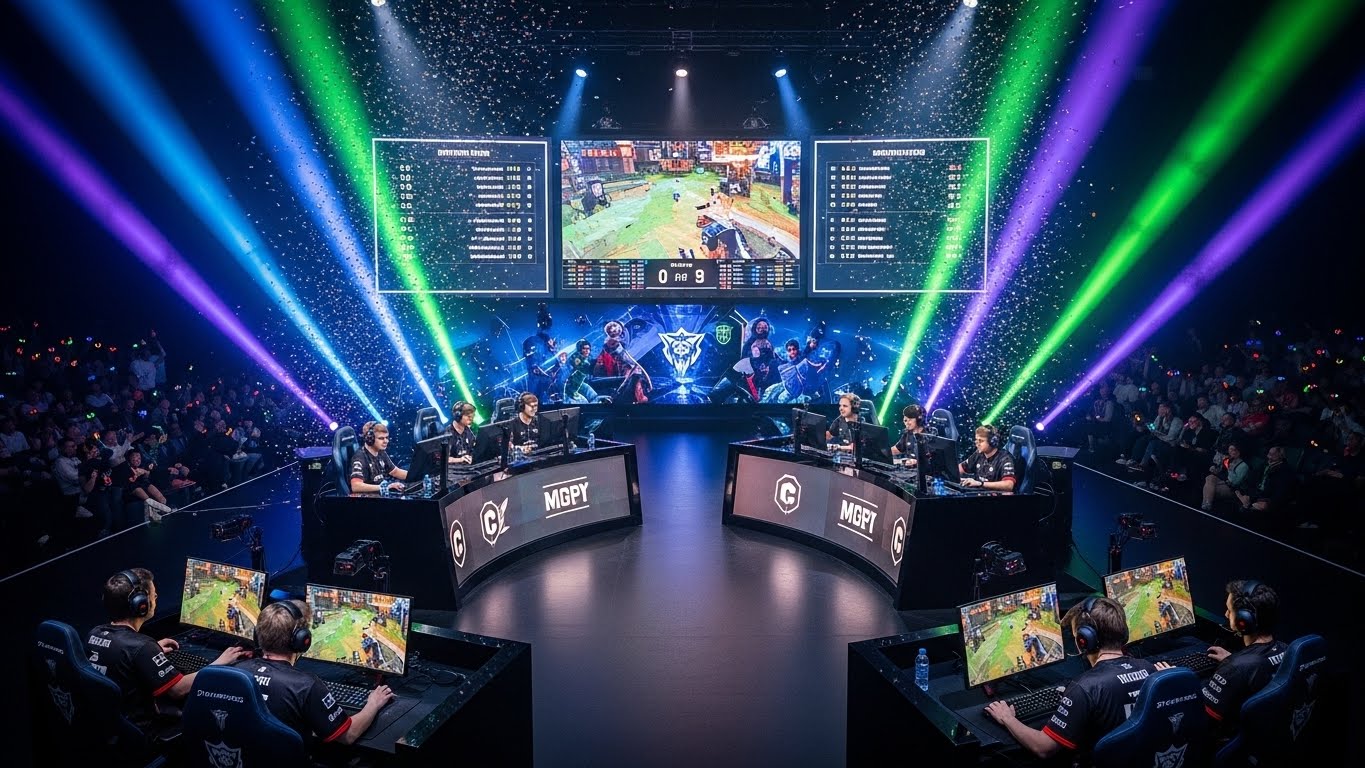
Competitive esports play introduces a cognitive layer that doesn't exist in solo gaming: the awareness of an opponent who is actively working against you and adapting to your strategies in real time. This creates what's sometimes called adversarial thinking — the habit of modeling another agent's decision-making process in order to anticipate their moves.
High-level competitive players develop a sophisticated ability to read patterns in opponent behavior, recognize tendencies, and identify moments when established patterns are about to break. This is a form of applied game theory operating at high speed, and it requires holding both your own strategy and a model of your opponent's strategy in mind simultaneously.
The social and performance dimensions of esports also add pressure that modifies how cognition operates. Managing performance under observation — with outcomes that can feel high-stakes — requires emotional regulation and the ability to maintain analytical clarity when impulse-driven responses are tempting. This is a genuine skill, and it's one that competitive gaming specifically helps develop in a way that single-player genres generally don't.
Genre Overlap and Cognitive Breadth
Most players don't stick to a single genre throughout their gaming lives, and the cognitive cross-training this produces is arguably its own benefit. A player who moves between FPS and strategy games may find that the rapid contextual processing from FPS play enhances their ability to respond to unexpected developments in a strategic situation, while the systems thinking from strategy games deepens their ability to anticipate opponent behavior in a shooter.
Genre diversity, in this sense, is worth cultivating not just for entertainment variety but for the range of cognitive orientations it produces. Each genre asks something slightly different from the player, and each builds something the others don't fully address. Understanding which genres you're comfortable with and which feel unfamiliar is one of the more interesting things a structured genre-based assessment can reveal about your own gaming history.
What This Means for How We Assess Gaming Knowledge
Genre-specific knowledge quizzes are particularly well-suited to revealing these cognitive patterns because they test understanding at the level of the genre itself — not just individual titles. Questions about how a genre evolved, what distinguishes it from adjacent categories, or how specific design choices within a genre reflect broader conventions require exactly the kind of informed awareness that deep genre engagement produces.
Someone with strong FPS familiarity will tend to have accurate intuitions about questions involving spatial design and tactical systems. Someone deeply experienced in RPGs will tend to do well on questions about narrative structure, world-building choices, and character progression systems. These patterns aren't perfectly predictive, but they're real, and they reflect the genuine intellectual texture of each genre.
Conclusion
The thinking styles that different game genres cultivate are real, varied, and worth paying attention to. Whether you're drawn to the rapid processing demands of FPS, the systems thinking of strategy, the narrative engagement of RPG, or the lateral thinking challenges of indie design, each genre is developing something distinct. Recognizing this doesn't require inflated claims about gaming's cognitive effects — it just requires taking genre conventions seriously as design choices that shape real patterns of engagement over time.